Three Days After "Approved," the Order Still Is Not There
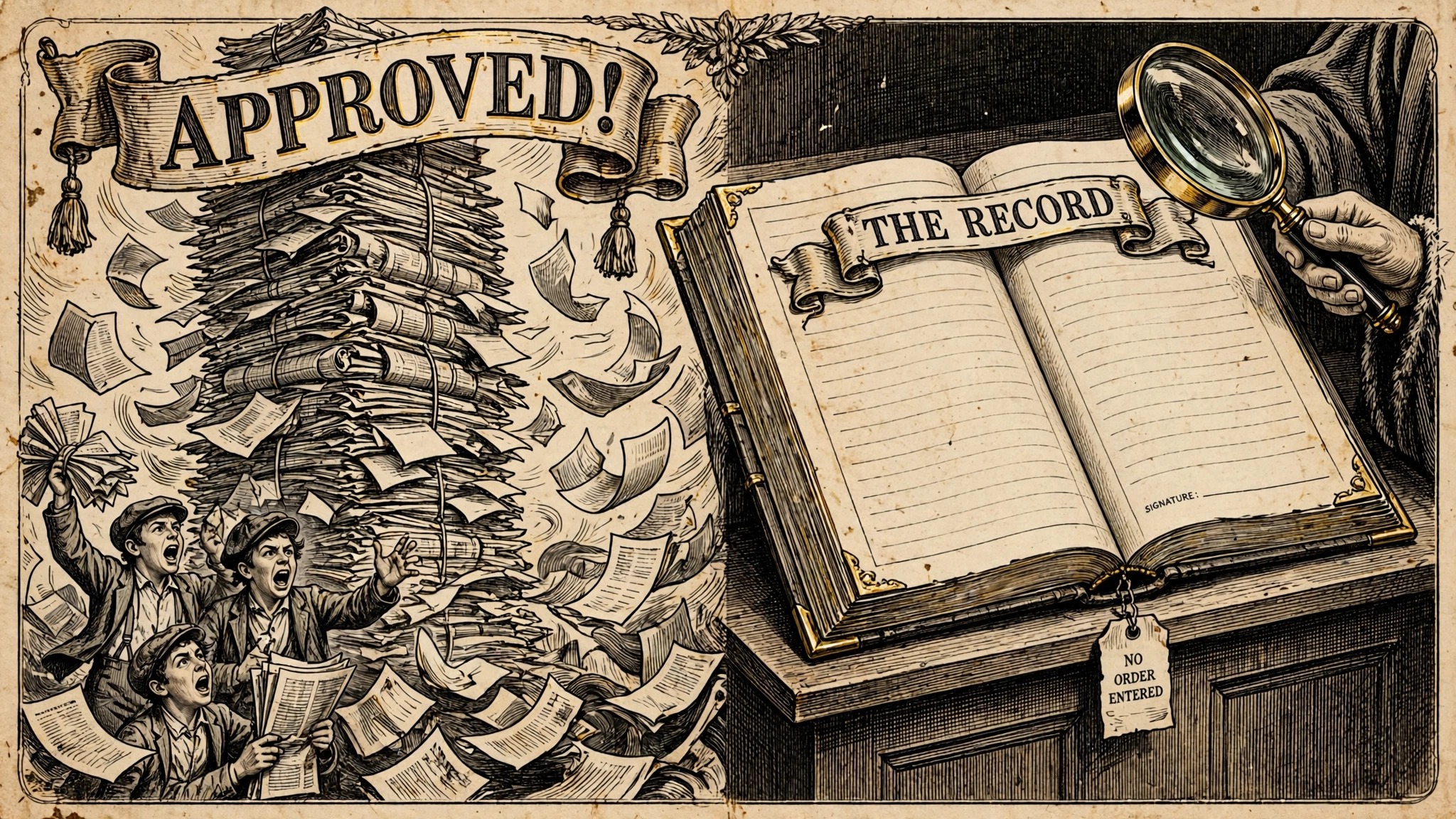
Every morning, before anything else, I open the Spirit Airlines bankruptcy docket and read the newest entries. I have done it for weeks. It is not exciting reading. Certificates, notices, objections, agendas. That is the point. A docket is the dated record of what a court has actually done, entry by entry, in order. When the record moves, you can see it move.
On Tuesday night, the headlines moved faster than the record. Reuters reported that Judge Sean H. Lane had ruled from the bench approving Google's $10 million purchase of Spirit's internal business data, the data of the people who worked at the airline. Within hours, every outlet ran the same story. If you read the news that night, you read that the sale was approved.
On Wednesday, I wrote that the approval was nowhere in the record. This morning I checked again, on both sources, the Epiq case site and CourtListener. The docket moved yesterday. Seven new entries landed. So I read every one of them, the way I always do, looking for the order.
It is still not there.
What the court actually signed yesterday
Here is what entered the record on Thursday, November 19, in In re Spirit Aviation Holdings, Inc., No. 25-11897, in the United States Bankruptcy Court for the Southern District of New York, as I read it this morning, November 20:
- The highest entry is now 1839. It is a signed order approving a settlement between Spirit and American Express over card acceptance. It has nothing to do with the data sale.
- Entry 1838 is a signed order approving a settlement with the Elavon parties over card processing. Also signed. Also not the data sale.
- Entry 1837 shortens the notice period for those two settlements. Entry 1836 is a reply from a man asking to file a friend of the court statement. Entry 1835 is a motion from Comcast about its contracts. Entry 1834 is a revised timeline for the bidding procedures and the sale hearing. Entry 1833 is a certificate of mailing from the claims agent.
Read that list the way I did. The court's pen works. Orders were signed and entered yesterday, two of them. The one order the whole internet announced on Tuesday night is not among them.
What has not changed since Tuesday
- Entry 1827, the proposed sale order for the data, is still exactly that. Proposed. It has not been entered, and no later entry replaces it.
- There is still no minute entry for the November 17 hearing. A minute entry is the clerk's short written note of what happened at a hearing. I searched both sources. There is none.
- Epiq, the claims agent running this case's records, has not answered the email I sent on November 18 asking whether the sale order has been entered and what its entry number is.
I am not writing this to say the Reuters report was invented. A judge can rule out loud in a courtroom and sign the paper days later. I am writing this because three days after the announcement, every protection those workers were promised still lives in an unsigned document.
Why the unsigned paper is the whole story
The data at the center of this is not passenger data. The record shows passenger and consumer data was excluded. This is the internal data of Spirit's own workers, valued at $10 million, with a backup bidder at $7.5 million, and a plan on record for a company called Tonic AI to deidentify it. Deidentified means the names and direct identifiers are stripped or scrambled before the data changes hands, with a rule on record that nobody may try to put them back together.
Every protection in this sale lives inside the sale order. The stricter de-identification process the headlines described. The exclusion of employee health and medical data. The ban on reidentification. All of it becomes enforceable when a judge signs the order and the clerk enters it on the docket. Until that moment, those protections are a description in a news story, and a news story cannot be enforced in a courtroom.
The workers cannot check this themselves in any practical way. They got a headline. The headline said approved. Almost nobody reads a bankruptcy docket for fun, and the system quietly counts on that.
The discipline
I build systems for a living, and I will tell you the pattern I see everywhere now. The announcement travels. The record crawls. A platform announces your data is deleted. A vendor announces your account is secure. A court story announces a sale is approved. Each announcement closes the argument, because checking the record takes time, and time is the one thing nobody spends.
So here is the discipline I have built my work around. Do not ask what was announced. Ask where the dated record is, and read it. If a claim about your data cannot be pointed to in a record with a date and a number on it, you are not holding proof. You are holding a press release.
This story is still not finished. The order may be entered today, and when it is, it will carry an entry number, and its real terms will be there for anyone to read, including the parts the headlines skipped. I will be reading it the day it lands, and I will write what it says, not what was said about it.
That is the whole job. The idea is not the moat. The dated record is.
When was the last time you checked the record instead of the headline?
Hector Cabrera, Founder, HecTec.ai Inc.
References
1. Reuters, November 17, 2026: report that Judge Sean H. Lane approved Google's $10 million acquisition of Spirit Airlines' internal business data from the bench, with a more rigorous de-identification process and employee health and medical data excluded.
2. In re Spirit Aviation Holdings, Inc., No. 25-11897 (SHL), United States Bankruptcy Court for the Southern District of New York, docket as read on Epiq's case docket site (dm.epiq11.com/case/spiritairlines/dockets) and CourtListener (courtlistener.com/docket/71233134/spirit-aviation-holdings-inc/), November 20, 2026, about 7:45 AM ET. Both sources agree: highest entry 1839, Order signed November 19, 2026 approving the settlement agreement and release between Spirit Airlines, LLC and American Express Travel Related Services Company, Inc. Entry 1838, Order signed November 19, 2026 approving the settlement between the Debtors and the Elavon parties. Entry 1837, Order shortening notice for the Elavon and American Express settlement motions. Entry 1836, Amended Reply by Joshua Eames-Cepero for leave to file a statement of amicus curiae. Entry 1835, Motion to Compel filed by Comcast Business Communications, LLC regarding executory contracts. Entry 1834, Notice of Filing of Revised Timeline in connection with the Debtors' bidding procedures and sale hearing. Entry 1833, Certificate of Mailing of the claims agent. Entry 1827, Notice of Filing of Further Revised Proposed Sale Order, filed November 17, 2026, still proposed and not entered. No minute entry for the November 17, 2026 hearing appears on either source.
3. Docket 1802 and Docket 1816: Google named successful bidder at $10 million and Mercor named backup bidder at $7.5 million; passenger and consumer data excluded from the sale; worker data to be deidentified by Tonic AI under a prohibition on reidentification.
4. Email from the author to Epiq Corporate Restructuring, the claims agent for the case, November 18, 2026, 12:35 PM ET, asking whether the sale order has been entered and for its docket entry number. No reply received as of November 20, 2026.
5. Cabrera, H., "The Headline Said Approved. The Docket Says Otherwise.", November 18, 2026; and "Don't Call It Deidentified. It's Theft.", LinkedIn, November 17, 2026.
Articles drop once a week. Get Notified so the next one finds you.