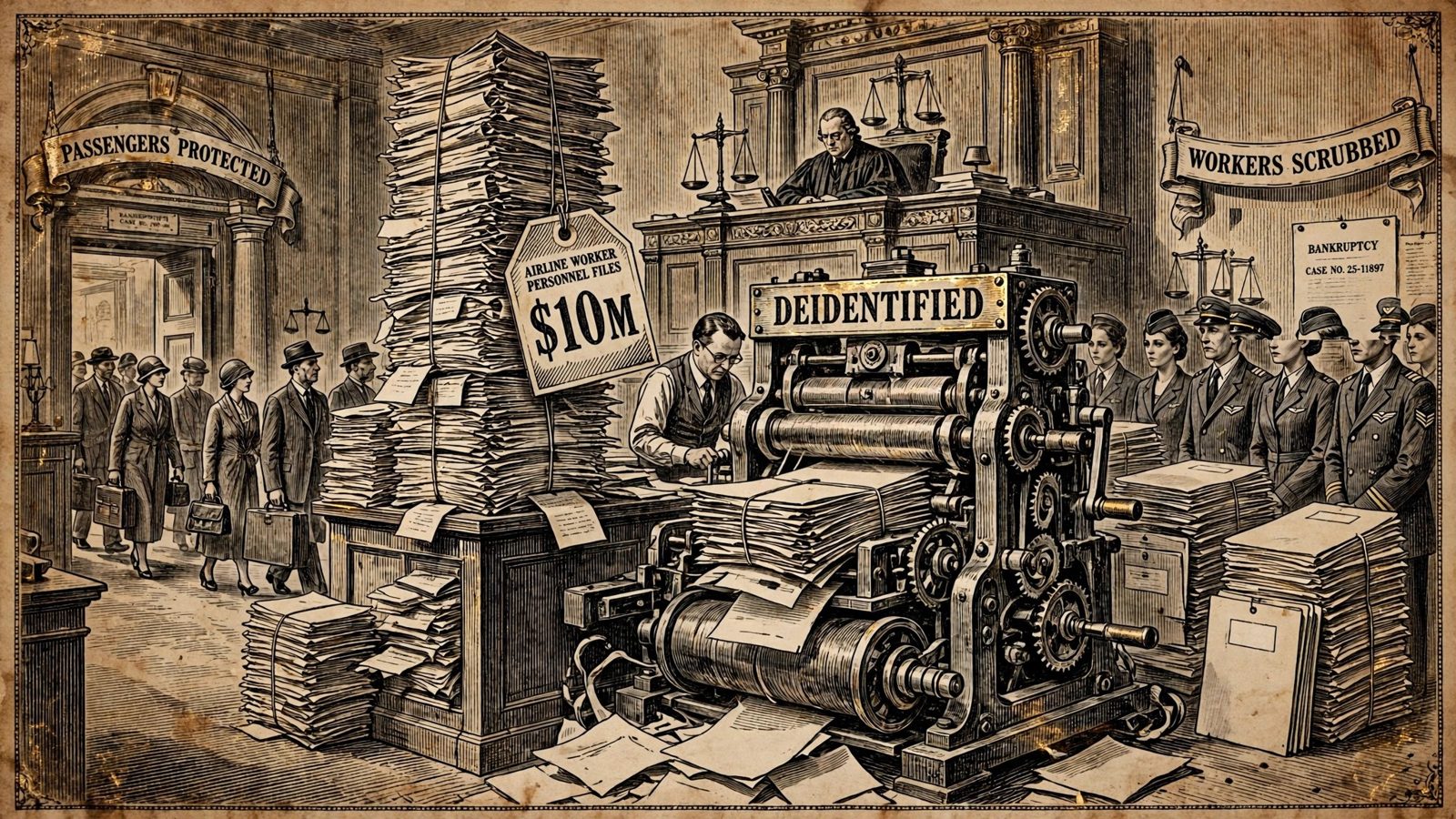
From the moment I started HecTec.ai Inc., my driving belief has been simple, yet profound: a human, not a company, should hold the key to their own data. I built Sovereignware because I've seen, time and again, how our personal information, our digital reflections, are treated not as extensions of ourselves, but as assets to be traded, sold, or even discarded without our consent. It's a core principle that I believe is fundamental to our digital rights.
This week, the stark reality of this problem is playing out in a courtroom in New York, shining a harsh light on how our identities can be stripped down and repurposed without our knowledge or explicit permission. Today, November 17, 2026, a hearing is scheduled in the United States Bankruptcy Court for the Southern District of New York. The case, In re Spirit Aviation Holdings, Inc., No. 25-11897, concerns the sale of assets from a company in distress.
At the heart of the matter is data. Not just any data, but data about people. Google has emerged as the successful bidder for a Spirit data asset, offering $10 million, with Mercor as the backup bidder at $7.5 million. This bid was filed on November 9, as documented under Docket 1802. While the specifics of this data asset are under review, the crucial distinction lies in whose data is protected and whose is, well, scrubbed.
Here's where it gets unsettling: passenger and consumer data are explicitly excluded from this sale. This means information related to customers, like travel histories or personal details, is not on the auction block. That's a good thing, a win for consumer privacy. However, the data belonging to the workers of Spirit Aviation Holdings, Inc. is being handled differently. It has been "deidentified" by Tonic AI, with a ban on reidentification.
Now, let's break down what "deidentified" really means for a non-IT audience. Imagine your personal data, your name, address, job, salary, health information, how long you've worked somewhere, is like a detailed portrait of you. When this data is "deidentified," it means certain direct identifiers, like your name, are removed. The intent is to make it harder to trace the data back to an individual. But "deidentified" is not the same as deleted, and it's certainly not anonymous. Research consistently shows that even with identifiers removed, sophisticated techniques can often re-link data back to individuals, especially when multiple data points are combined. This process, known as "reidentification," means that your unique digital portrait can potentially be reconstructed, even if your name isn't written on it. This is why a "ban on reidentification" is put in place, but it highlights the inherent risk.
So, while passengers got protected, workers got scrubbed. Their data, deemed an asset of the bankrupt company, is being sold in a state that is supposedly anonymous, but arguably leaves them vulnerable. This illustrates a fundamental flaw in our current data landscape: data about people gets sold in bankruptcy because no one has to ask the human it belongs to. It's treated as a company's property, not an individual's.
Airbus and IAE, key stakeholders in the airline industry, are still objecting to aspects of this sale, with their objections filed on November 13, 2026. It's important to note that the judge, Sean H. Lane, has not yet ruled on the matter, and the sale is not yet approved. The outcome of today's hearing is still uncertain.
This situation underscores the urgent need for a shift in how we perceive and manage personal data. My work with Sovereignware at HecTec.ai Inc. is precisely about addressing this. We believe the fix is rooted in individual permission and authentication. Nothing moves, nothing is shared, nothing is sold unless the human whose data it is explicitly says so. Sovereignware provides a mechanism for individuals to grant, manage, and revoke access to their data with cryptographic certainty, ensuring true control.
Your digital self is a part of you. Shouldn't you be the one to decide its fate?
References
- Docket 1802, filed November 9, 2026 (Google's $10M bid for Spirit data asset).
- In re Spirit Aviation Holdings, Inc., No. 25-11897, Bankr. S.D.N.Y.
- Hearing scheduled for November 17, 2026, 11:00 AM ET, United States Bankruptcy Court for the Southern District of New York, before Judge Sean H. Lane.
- IAE Data Objection and Airbus Objection, filed November 13, 2026.
The Question
What are your thoughts on data about people being treated as a corporate asset, especially in bankruptcy proceedings? Do you believe "deidentified" data truly protects individuals?
Articles drop once a week. Get Notified