Articles / Doctrine
Altman and Anthropic aren't scared for you — they're scared of you.
October 2026 · 3 min read
Hector Cabrera
Marketing AI Product Leader | Enterprise Data Governance & Sovereign MarTech Architecture
October 5, 2026
A year ago I tried to take my own data out of Google.
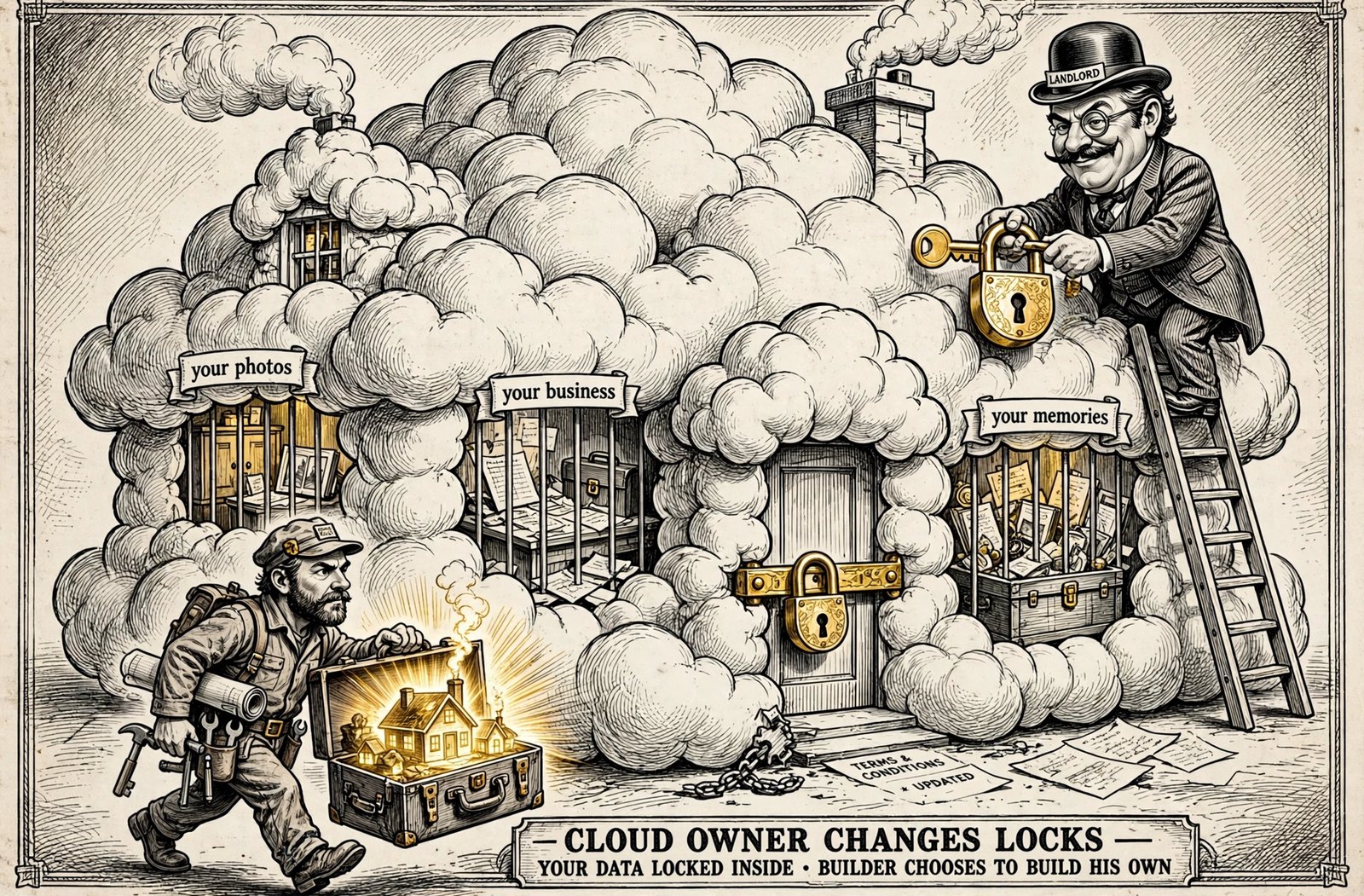
Not someone else's. Mine. My photos, my files, my life. And Google Takeout made it as difficult as possible to get the full raw thing out the door. That was the moment I understood something: I'm not a customer. I'm a tenant.
So I started building. I called it Hec Life. I was frustrated with how scattered everything felt, and I needed something that would run my life the way I needed it run. On November 27th of last year, that idea became an invention.
For eight months I built nights and weekends. Two, three AI subscriptions — sixty bucks a month — and a regular person with an idea could outbuild entire teams. That was the window.
That window is closing.
Now I get an hour and a half of coding before the limits hit. Your limit is full and clawed back. Four sessions a week if you're lucky. The same companies that handed out the keys are now changing the locks, and they're doing it while telling you it's for your safety.
Let's be honest about what "AI is too dangerous" really means. In 2023, Sam Altman sat before the U.S. Senate and said: "I think if this technology goes wrong, it can go quite wrong... We want to work with the government to prevent that from happening." He asked Washington to license AI development — licenses his company would help write.
Last month, Anthropic's Dario Amodei published an essay titled "We Must Pace the Frontier": "We must slow the pace at which we improve the capabilities of AI models." He told the UN Security Council that AI could "be a risk to humanity as a whole," and when asked about a kill switch that could forcibly shut down AI systems, he said it "could be a good idea."
Read that again. The people selling you the intelligence are asking for the off switch — and offering to hold it.
In my last piece I argued AI is becoming the electric bill. This is the sequel: what happens when the power company decides you're using too much?
They're not scared for you. They're scared of you. People figured out how to train their own AI through their AIs — and a local model, trained on your own data, on your own hardware, is going to beat their cloud model for your life. That shocked them. So now the answer is limits, gates, and kill switches.
I feel bad for the person starting today. I got my eight months. They're not going to get theirs.
Here's what I have that they can't take: my vault. My raw data. Reasoning that runs on hardware I own. If the big labs turned everything off tomorrow — if the internet went dark tonight — I keep working. My AI works like a Word document works. It doesn't phone home. It doesn't ask permission. It's mine.
So what do you actually do? Start small. Pull your data out — all of it, the raw files, not the summary export. Run one model locally and feel what it's like when nothing phones home. Keep your reasoning where you can touch it. Ownership isn't a purchase. It's a habit.
Now ask yourself the question one level deeper: if your AI got turned off tonight, what would you lose?
Not hypothetically. Your photos — could you even find one in your own album without their search? Your business workflows, your client reasoning, your memory. Gone. And here's the part nobody says out loud: your data was already bought, sold, and trained on somewhere else. Not by you. Not for you.
So you have two choices. Tenant or owner.
I chose owner. I built the house, I hold the keys, and nobody's changing my locks.
What are you going to do when they slow you down?
Sources
- Sam Altman, U.S. Senate Judiciary subcommittee testimony (May 16, 2023) — Computing
- Dario Amodei, “We Must Pace the Frontier” (September 2026)
- Amodei at the UN Security Council (September 23, 2026) — Newsweek
- Amodei on an AI kill switch (September 2026) — CBS News
Own the house. Hold the keys.
See the ArkNode Fall Cohort →
Read the Executive White Paper →
Explore Sovereign Beacon™ Ratings
Our articles outline the philosophy of data dignity; our ratings hold the industry accountable.
View all Sovereign Beacon™ privacy & security ratings →
Recent assessments:
• OpenAI ChatGPT (Consumer & Free Plans) — Critical
• Apple Vision Pro — Critical
• Signal Private Messenger — Sovereign
• GrapheneOS on Google Pixel — Sovereign